Historics at Brooklands has its last sale of 2012 at the end of November, and is looking to finish the year on a high. The lot list for the sale continues to grow – it is approaching 100 – and there’s plenty of action for those with an AROnline taste in cars.
Most of you will know that it is AROnline’s settled position that the Vauxhall Cavalier Mk1 is the best British-badged mid-sized saloon of the 1970s, but probably a few less will know that this car was also something of a Capri-beater in period, too. The Cavalier was available in Coupe and Sportshatch form, both of which were essentially Opel Mantas in a more sober suit for those who didn’t need to be quite so obvious…
Historics is offering a very nice Coupe in its sale. It’s a 2000GLS automatic has only had two owners from new and has covered less than 1000 miles since 1995, with a total mileage of 79,600. The seller has described the engine and gearbox to be in ‘excellent condition throughout and driving beautifully when warmed up’. This Vauxhall car comes with V5C registration document, the old V5 registration document showing the ownership change, an MoT test certificate from 1995 with the mileage of 78,707 and second MoT certificate dated 2006 when the mileage was 79,547. Estimate is a salty £2800-3800, and expect bidding to peter out before this…
Of more interest, though is this wonderful curio, for those who love Rover P6s (and let’s face it, who doesn’t?) Genuine US-spec models are as rare as rot-free Rover 100s in the UK, so this ex-California car (estimate £7000-9000) is going to attract significant interest. The Rover P6 Nada was restored in 2001, and is fitted with a 3.9-litre engine for a little extra urgency. As it’s an ex-California car, and will have been fitted with significant anti-smog gear, it probably needed a little help. It’s an award-winning example of a great car, and for those who like the US specification changes, well worth a closer look.
Other cars that attracted our interest at the sale include a 1961 Standard Vanguard Vignale £4250-7500), and a 1978 Jaguar XJ-C by Lynx Engineering. The sale catalogue is online, all estimates and details included.
Saturday, 3 November 2012
Friday, 2 November 2012
What an RAF pilot can teach us about being safe on the road
“Sorry mate, I didn’t see you”. Is a catchphrase used by drivers up and down the country. Is this a driver being careless and dangerous or did the driver genuinely not see you?
According to a report by John Sullivan of the RAF, the answer may have important repercussions for the way we train drivers and how as cyclists we stay safe on the roads.
John Sullivan is a Royal Air Force pilot with over 4,000 flight hours in his career, and a keen cyclist. He is a crash investigator and has contributed to multiple reports. Fighter pilots have to cope with speeds of over 1000 mph. Any crashes are closely analysed to extract lessons that can be of use.
These threats are largely gone and they’ve been replaced by vehicles travelling towards us at high speeds. This, we’ve not yet adapted to deal with.
Why?
Light enters our eyes and falls upon the retina. It is then converted into electrical impulses, that the brain perceives as images. Only a small part of your retina, the centre bit called the fovea, can generate a high-resolution image. This is why we need to look directly at something, to see detail.The rest of the retina lacks detail but it contributes by adding the peripheral vision. However, a mere 20 degrees away from your sightline, your visual acuity is about 1/10th of what it is at the centre.
That’s not to say that we cannot see something in our peripheral vision – of course we can. As you approach a roundabout, you would be hard pressed not to see a huge lorry bearing down upon you, even out of the corner of your eye – obviously, the bigger the object, the more likely we are to see it. But would you see a motorbike, or a cyclist?To have a good chance of seeing an object on a collision course, we need to move our eyes, and probably head, to bring the object into the centre of our vision – so that we can use our high-resolution vision of our fovea to resolve the detail.
When you move your head and eyes to scan a scene, your eyes are incapable of moving smoothly across it and seeing everything. Instead, you see in the image in a series of very quick jumps (called saccades) with very short pauses (called fixations) and it is only during the pauses that an image is processed.
Your brain fills in the gaps with a combination of peripheral vision and an assumption that what is in the gaps must be the same as what you see during the pauses.
This might sound crazy, but your brain actually blocks the image that is being received while your eyes are moving. This is why you do not see the sort of blurred image, that you see when you look sideways out of a train window.
The only exception to this, is if you are tracking a moving object.
In the past, this served us well. It meant we could creep up on antelopes without our brain being overloaded by unnecessary detail and a lot of useless, blurred images.
However, what happens when this system is put to use in a modern day situation, such as a traffic junction?
This isn’t really a case of a careless driver, it’s more of a human incapacity to see anything during a saccade. Hence the reason for so many “Sorry mate, I didn’t see you” excuses.The faster you move your head, the larger the jumps and the shorter the pauses. Therefore, you’ve got more of a chance of missing a vehicle.We are effectively seeing through solid objects, with our brain filling in the image.Additionally, we tend to avoid the edges of the windscreen. The door pillars on a car therefore create an even wider blindspot. This is called windscreen zoning.

Forewarned is forearmed, so here’s what we can do.Drivers:
Two important takeaways for cyclists: Increasing your contrast helps you be seen. Think flashing bike lights. Also, remember the importance of good road positioning.
According to a report by John Sullivan of the RAF, the answer may have important repercussions for the way we train drivers and how as cyclists we stay safe on the roads.
John Sullivan is a Royal Air Force pilot with over 4,000 flight hours in his career, and a keen cyclist. He is a crash investigator and has contributed to multiple reports. Fighter pilots have to cope with speeds of over 1000 mph. Any crashes are closely analysed to extract lessons that can be of use.
Our eyes were not designed for driving
We are the result of hundreds of thousands of years of evolution. Our eyes, and the way that our brain processes the images that they receive, are very well suited to creeping up on unsuspecting antelopes and spotting threats such as sabre-toothed tigers.These threats are largely gone and they’ve been replaced by vehicles travelling towards us at high speeds. This, we’ve not yet adapted to deal with.
Why?
Light enters our eyes and falls upon the retina. It is then converted into electrical impulses, that the brain perceives as images. Only a small part of your retina, the centre bit called the fovea, can generate a high-resolution image. This is why we need to look directly at something, to see detail.The rest of the retina lacks detail but it contributes by adding the peripheral vision. However, a mere 20 degrees away from your sightline, your visual acuity is about 1/10th of what it is at the centre.
Try this scary test to see quite how much detail you lose in your peripheral vision
- Stand 10 metres away from a car.
- Move your eyes and look just one car’s width to the right or left of that car.
- Without moving where you eyes are now looking, try and read the number plate of the car.
- Try the test again from 5m.
That’s not to say that we cannot see something in our peripheral vision – of course we can. As you approach a roundabout, you would be hard pressed not to see a huge lorry bearing down upon you, even out of the corner of your eye – obviously, the bigger the object, the more likely we are to see it. But would you see a motorbike, or a cyclist?To have a good chance of seeing an object on a collision course, we need to move our eyes, and probably head, to bring the object into the centre of our vision – so that we can use our high-resolution vision of our fovea to resolve the detail.
Here’s when things get really interesting
Your brain fills in the gaps with a combination of peripheral vision and an assumption that what is in the gaps must be the same as what you see during the pauses.
This might sound crazy, but your brain actually blocks the image that is being received while your eyes are moving. This is why you do not see the sort of blurred image, that you see when you look sideways out of a train window.
The only exception to this, is if you are tracking a moving object.
Another test to try
If you are not convinced, try this test.- Look in a mirror.
- Look repeatedly from your right eye to your left eye.
- Can you see your eyes moving? You can’t.
- Repeat the test with a friend and watch them. You will see their eyes moving quite markedly.
In the past, this served us well. It meant we could creep up on antelopes without our brain being overloaded by unnecessary detail and a lot of useless, blurred images.
However, what happens when this system is put to use in a modern day situation, such as a traffic junction?
Why we miss motorbikes and bicycles
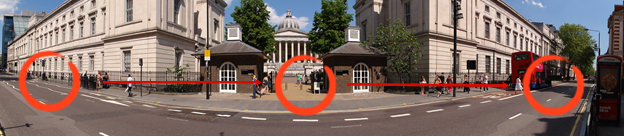
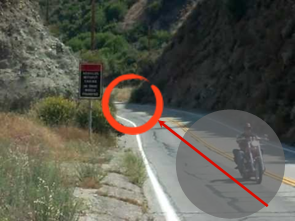
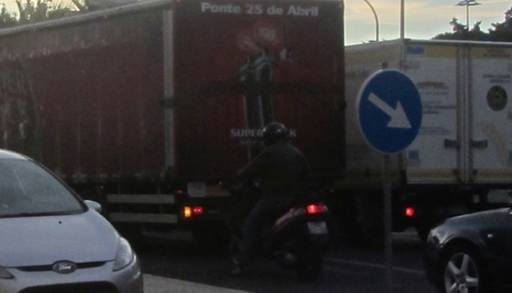
At a traffic junction all but the worst of drivers will look in both directions to check for oncoming traffic. However, it is entirely possible for our eyes to “jump over” an oncoming bicycle or motorbike.The smaller the vehicle, the greater the chance it will fall within a saccade.The danger of playing music
Our ears help us build up a picture of our surroundings. However, inside our cars or with music playing, our brain is denied another useful cue. Additionally, bicycles are almost completely silent, so won’t be heard by car drivers.How accidents happen
Let’s say you are driving along. You approach a junction and you notice a lack of traffic. You look left and right and proceed forward. Suddenly you hear the blast of a horn, as a motorbike flashes in front of you, narrowly avoiding an accident.What just happened?On your approach, you couldn’t see there was another vehicle on a perfect collision course. With a lack of relative movement for your peripheral vision to detect and the vehicle being potentially hidden by being near the door pillar, you miss it entirely.Lulled into a false sense of security you looked quickly right and left, to avoid holding up the traffic behind you, and your eyes jumped cleanly over the approaching vehicle, especially as it was still close to the door pillar in the windscreen. The rest of the road was empty, and this was the scene that your brain used to fill in the gaps! Scary, huh?You were not being inattentive – but you were being ineffective.Additionally, if you didn’t expect there to be a cyclist your brain is more likely to automatically jump to the conclusion that the road is empty.Now that you’ve been warned. What can you do?
Forewarned is forearmed, so here’s what we can do.Drivers:
- Slow down on the approach of a roundabout or junction. Even if the road seems empty. Changing speed will allow you to see vehicles that would otherwise be invisible to you.
- A glance is never enough. You need to be as methodical and deliberate as a fighter pilot would be. Focus on at least 3 different spots along the road to the right and left. Search close, middle-distance and far. With practise, this can be accomplished quickly, and each pause is only for a fraction of a second. Fighter pilots call this a “lookout scan” and it is vital to their survival.
- Always look right and left at least twice. This doubles your chance of seeing a vehicle.
- Make a point of looking next to the windscreen pillars. Better still, lean forward slightly as you look right and left so that you are looking around the door pillars. Be aware that the pillar nearest to you blocks more of your vision. Fighter pilots say ‘Move your head – or you’re dead’.
- Clear your flight path! When changing lanes, check your mirrors and as a last check, look directly at the spot which are going to manoeuvre.
- Drive with your lights on. Bright vehicles or clothing is always easier to spot than dark colours that don’t contrast with a scene.
- It is especially difficult to spot bicycles, motorbikes and pedestrians during low sun conditions as contrast is reduced.
- Keep your windscreen clean – seeing other vehicles is enough of a challenge without a dirty windscreen. You never see a fighter jet with a dirty canopy.
- Finally, don’t be a clown – if you are looking at your mobile telephone then you are incapable of seeing much else. Not only are you probably looking down into your lap, but your eyes are focused at less then one metre and every object at distance will be out of focus. Even when you look up and out, it takes a fraction of a second for your eyes to adjust – this is time you may not have.
- Recognise the risk of being in a saccade. High contrast clothing and lights help. In particular, flashing LED’s (front and rear) are especially effective for cyclists as they create contrast and the on-off flashing attracts the peripheral vision in the same manner that movement does. There’s nothing wrong with leaving these on during the day. (Especially if they are rechargeable)
- The relatively slower speed of bicycles means that they will be closer to a point of collision if a vehicle begins to pull into their path. Turn this to advantage – when passing junctions, look at the head of the driver that is approaching or has stopped. The head of the driver will naturally stop and centre upon you if you have been seen. If the driver’s head sweeps through you without pausing, then the chances are that you are in a saccade – you must assume that you have not been seen and expect the driver to pull out!
- Recognise that with a low sun, a dirty windscreen or one with rain beating against it drivers are likely to have less of a chance of seeing you.
- Cycle instructors have been saying it for years: Ride in a position further out from the kerb as a driver is more likely to be looking in this location. See: How to make your next bike ride safer than the last.
What should we do with our human weakness?
John Sullivan’s findings and suggestions are excellent. However, they rely on drivers changing well embedded habits. Personally I believe that, unlike RAF pilots, a driver is very unlikely to change their behaviour. Therefore, I’d suggest that this is another reason we should be looking at building safety in to our roads, with Dutch style cycling infrastructure.Two important takeaways for cyclists: Increasing your contrast helps you be seen. Think flashing bike lights. Also, remember the importance of good road positioning.
Join the Fair Fuel UK Campaign and use their easy link to write to your MP to scrap the planned rise
Only 8 Weeks to the 3p/Litre Tax Hike on Petrol & Diesel. Please Email your MP to Scrap this Crippling Tax Rise
With just over a month to the Chancellor’s Autumn Statement, we’re stepping up our fight to stop the 3p per litre Fuel Duty Rise planned for 1st January 2013. That represents over 16p a gallon (combined Fuel Duty and VAT). Petrol and diesel prices are still far too high. The economy is still on its knees. Hitting families and businesses with this tax hike is the last thing that the economy needs.
We need you to get in touch with your MP and ask them to support our fight in a number of ways. Please use this link to contact your MP. Some people say that ‘writing/emailing your MP doesn’t work’ – but remember, with your help, we have successfully fought off over 9p per litre of Fuel Duty rises in the last 20 months. That's £4.5 Billion less of tax paid by us all.
Here’s the link http://action.fairfueluk.com/Stop3pRise
Only a few days ago, our National spokesman Quentin Willson led a delegation of FairFuelUK backers to meet Chief Secretary to the Treasury, Danny Alexander MP. (Photo)
We presented him with a report that set out the damage that the 3p rise will do to the economy – 35,000 jobs destroyed and growth hit hard. The report also explained why it would be in the Government’s own interest to CUT Fuel Duty. If you’d like to see this report yourself please download it.
There’s a summary report here http://www.fairfueluk.com/niesr_report.html and the full detailed report itself can be downloaded on the same page. Pictures of our visit to The Treasury are at http://www.fairfueluk.com/fairfueluk_images.html
We have a real chance of seeing off this rise. This is only possible because of your support and that of our major backers – the RAC, the Road Haulage Association (RHA), the Freight Transport Association(FTA), Aldermore Bank, and Palletline. Particular thanks are due to the RHA which funded the report referred to above and to the FTA which funded a similar report earlier in the year. Without the backing of these organisations, it’s fair to say that we’d all be paying about 9p per litre (11p including the VAT) more for our fuel. If you get a chance, please visit their sites.
As well as fighting the 3p rise and campaigning for a CUT in Fuel Duty we are continuing to press the case for fairer petrol & diesel prices on other fronts.
1. On our call to have the Fuel Duty listed on all till receipts from forecourts see http://www.fairfueluk.com/all_on_receipt.html we have had over 15,000 supporters backing this initiative. Robert Halfon MP with your support has secured a further debate in late November to push this through. We need to keep up the pressure.
2. FairFuelUK has met with the Office of Fair Trading to investigate the supply of petrol & diesel, the fairness of pricing and for the authorities to investigate the rigging of Oil markets. We presented over 2000 pieces of evidence to the OFT that FairFuelUK supporters supplied. If you any more please go to http://www.fairfueluk.com/callforinformation.html
3. Lastly, please spread word of our campaign – we’ve achieved so much with our 340,000 supporters – just think what we can do if we get a million! Please spread the word to your email lists and on Facebook and Twitter. We’re entering a very busy phase of the campaign and any help you could give by purchasing and displaying a campaign sticker would be hugely appreciated http://www.fairfueluk.com/campaign_support.html
With just over a month to the Chancellor’s Autumn Statement, we’re stepping up our fight to stop the 3p per litre Fuel Duty Rise planned for 1st January 2013. That represents over 16p a gallon (combined Fuel Duty and VAT). Petrol and diesel prices are still far too high. The economy is still on its knees. Hitting families and businesses with this tax hike is the last thing that the economy needs.
We need you to get in touch with your MP and ask them to support our fight in a number of ways. Please use this link to contact your MP. Some people say that ‘writing/emailing your MP doesn’t work’ – but remember, with your help, we have successfully fought off over 9p per litre of Fuel Duty rises in the last 20 months. That's £4.5 Billion less of tax paid by us all.
Here’s the link http://action.fairfueluk.com/Stop3pRise
Only a few days ago, our National spokesman Quentin Willson led a delegation of FairFuelUK backers to meet Chief Secretary to the Treasury, Danny Alexander MP. (Photo)
We presented him with a report that set out the damage that the 3p rise will do to the economy – 35,000 jobs destroyed and growth hit hard. The report also explained why it would be in the Government’s own interest to CUT Fuel Duty. If you’d like to see this report yourself please download it.
There’s a summary report here http://www.fairfueluk.com/niesr_report.html and the full detailed report itself can be downloaded on the same page. Pictures of our visit to The Treasury are at http://www.fairfueluk.com/fairfueluk_images.html
We have a real chance of seeing off this rise. This is only possible because of your support and that of our major backers – the RAC, the Road Haulage Association (RHA), the Freight Transport Association(FTA), Aldermore Bank, and Palletline. Particular thanks are due to the RHA which funded the report referred to above and to the FTA which funded a similar report earlier in the year. Without the backing of these organisations, it’s fair to say that we’d all be paying about 9p per litre (11p including the VAT) more for our fuel. If you get a chance, please visit their sites.
As well as fighting the 3p rise and campaigning for a CUT in Fuel Duty we are continuing to press the case for fairer petrol & diesel prices on other fronts.
1. On our call to have the Fuel Duty listed on all till receipts from forecourts see http://www.fairfueluk.com/all_on_receipt.html we have had over 15,000 supporters backing this initiative. Robert Halfon MP with your support has secured a further debate in late November to push this through. We need to keep up the pressure.
2. FairFuelUK has met with the Office of Fair Trading to investigate the supply of petrol & diesel, the fairness of pricing and for the authorities to investigate the rigging of Oil markets. We presented over 2000 pieces of evidence to the OFT that FairFuelUK supporters supplied. If you any more please go to http://www.fairfueluk.com/callforinformation.html
3. Lastly, please spread word of our campaign – we’ve achieved so much with our 340,000 supporters – just think what we can do if we get a million! Please spread the word to your email lists and on Facebook and Twitter. We’re entering a very busy phase of the campaign and any help you could give by purchasing and displaying a campaign sticker would be hugely appreciated http://www.fairfueluk.com/campaign_support.html
GROWTH and jobs in Britain will significantly outstrip the EU’s next year, experts predict.
The National Institute of Economic and Social Research said our economy will expand by 1.1 per cent, while the eurozone will flatline.
Unemployment will also stabilise at around eight per cent in the UK — but soar to 25 per cent in some single currency countries.
The projections were another boost for the Government after figures last week showed that Britain has burst out of recession.
But because of the global economic downturn this year, George Osborne won’t be able to wipe out the deficit until 2018 — meaning cuts and tax rises for SIX more years. NIESR said: “Risks to the UK economy are dominated by the external environment.”
Unemployment will also stabilise at around eight per cent in the UK — but soar to 25 per cent in some single currency countries.
The projections were another boost for the Government after figures last week showed that Britain has burst out of recession.
But because of the global economic downturn this year, George Osborne won’t be able to wipe out the deficit until 2018 — meaning cuts and tax rises for SIX more years. NIESR said: “Risks to the UK economy are dominated by the external environment.”
True Brits! Meet the new breed of Tory MPs who defied their leader over the EU (and most have had jobs in the real world)
There is a genre of action films (eg Kelly’s Heroes) in which desperadoes from various unlikely occupations are moulded into a formidable fighting force. They usually include a charmer, a lush, a bespectacled nerd and, more often than not, a pickpocket.
After early setbacks they become firm comrades and with a few expertly thrown hand-grenades save the day for king and country.
Much the same may be happening with the 2010 intake of Conservative MPs who on Wednesday, in an act of rare parliamentary defiance, told the Coalition Government to be tougher with Brussels over the EU Budget.
Half the 53 Tories who rebelled were ‘newbies’ — ie MPs who only entered the Commons at the last general election.
The amendment which won the night was put by 2010 intaker Mark Reckless, from Kent. Bespectacled Mr Reckless, 41, who has a computer-geek’s voice, spoke with striking, controlled anger about how Europe wastes his constituents’ money.
To see this physically awkward backbencher — previously known best for being a late-night tippler — rise up and conquer the smoothies of Establishment Euro-orthodoxy was the most marvellous moment.
At first inspection the 2010 Tory newcomers are a disparate bunch, markedly so in an era of ‘professional’ politicians. They include a former UN commander in Bosnia, an opera singer, a jockey, a couple of former TV autocuties, a former adviser to the Queen, an Iraqi immigrant, an MI6 man, a history teacher and a former diplomat who at the age of 30 pretty much governed a province of Iraq.
Throw in some lawyers, soldiers, several self-made business men and women, a Welsh-farming grandfather, City types and even an international male pin-up and plutocrat, and you have nothing short of political minestrone. What a contrast they make to the trade unionists and ‘third sector’ professionals of the Labour benches.
Received wisdom has it that the Cameron Tories are nothing but a gang of toffee-nosed Etonians with trust funds. In reality, the modern parliamentary party is unpredictable, clever, independent-minded — as it showed on Wednesday.
Looking down the list of EU budget rebels one finds the name of Bob Stewart (Beckenham), 63, who won the DSO while commanding UN forces in Bosnia in the early 1990s. ‘Colonel Bob’ is a convivial fellow, not necessarily one for small print (particularly after sundown), but possessed of a dogged bloody-mindedness.
When you have gone eyeball to eyeball with murderous Serbs it is not such a big thing to tell a Whip where to hop off the bus.
Others who defied the Whips on Wednesday included Tracey Crouch, 37, a soccer coach and former aide to ex-Tory leader Michael Howard. Miss Crouch, who won Chatham from Labour at the last election, lives for politics (she has yet to find a husband) but she is not a careerist in the dreary sense. She prefers to accept Brownie points from her electors rather than her Whips.
Voting alongside her was burly Andrew Percy (Brigg & Goole), 35, a persistent cock-snooker at the Whips. Ex-teacher Percy would never have tolerated such cheek from his secondary school pupils but he is doing what he thinks his Lincolnshire and East Yorkshire voters want.
Also there: gritty Lancashire solicitor David Nuttall (Bury North), 50; ex-Army officer Adam Holloway (Gravesham), 47; Thatcherite gay-rights campaigner Conor Burns (Bournemouth W), 40; gulpy James Wharton, a solicitor from Stockton South, who is just 28 years old and looks even younger.
Sarah Wollaston, 50, another rebel, is a doctor and mother of three who was picked as Tory candidate for Totnes by an open primary (ie by members of the public rather than just by Tory members). Dr Wollaston, having arrived at Westminster as a political ingenue, seems immune to the usual Commons traits of job-watching and policy-wonk positioning. She examines the evidence, listens to constituents and makes her decision.
She may not be a tub-thumper but this is surely what is meant to happen in a representative democracy. You represent the people, not the vested interests or the cocooned officials.
It is a sign of how unconnected from the voters our politics became in the New Labour years that we find such behaviour noteworthy.
Time and again in the current Commons, it is on the Tory benches where the interesting debates are to be heard. The same occurs in the select committees.
On the Public Accounts Committee, much of the really forensic questioning of civil servants is done by a Tory firebrand called Steve Barclay (NE Cambs), 40, a top former anti-money-laundering investigator with the Financial Services Authority and Barclays.
The newbies are being encouraged by former ministers who have returned to the backbenches and have little affinity with Mr Cameron or, more often, George Osborne. With the select committees now chosen by secret ballot, being a backbencher offers more chances for individuality than in the past.
And with no party having a majority, the Whips have never been weaker, the Coalition having diluted their powers of patronage.
When you have a majority of only 176, as opera singer Nicola Blackwood, 33, does in Oxford West (where she defeated creepy Lib Dem Evan Harris), you tend to crack on with your political life while you can.
But it is not mere circumstance which makes these Tory newbies impressive. They seem to be driven by a plain exasperation at the state into which our country has fallen.
Coming from such varied jobs, often from outside the political ‘village’, they are impatient for change and do not mind crushing a few old time-servers in the process, as recent elections to the Tory backbench 1922 committee showed.
The 2010-ers are a now a major force and they will decide the politics and personality of the next party leader,’ says a member of the 1997 intake. ‘They are small-state, Eurosceptic, pro-grammar schools, doubtful about green issues. They also tend to know what they’re talking about. Most unusual!’
Some of the 2010 Tories have already shot into ministerial positions. They include Treasury Minister Sajid Javid, 42, a Bristol bus driver’s son who became an international banker, and Liverpudlian Esther McVey, 45, a children’s TV presenter who went on to found a successful training company. Her ‘Liver Birds’ accent is a glory to behold at the Despatch Box.
Mr Javid, Miss McVey and other high-flying 2010-ers such as gynaecologist ‘Dishy’ Dan Poulter, 34, and mechanical engineer Alec Shelbrooke, 36, a barrel-tummied force of nature snorting with Yorkshire common-sense could not rebel because they are now on the front bench. Same is true of lots of ministerial aides. But I bet they watched with admiration.
The 2010-ers are not above a little envy. Some have mixed feelings about the publicity given to former Bank of England economist and Business Minister Matt Hancock, and to Dominic Raab (Esher & Walton), a brilliant lawyer from a Czech émigré family who is expert on European law.
However, we mustn’t become rosy-tinted about all the 2010 intake. Some have not shined as one would have hoped, among them was Louise Mensch, 41, who after a promising start, quit her Corby seat to move to New York.
But she and a few other mouldy apples are more than compensated for by the likes of Suffolk Coastal’s Therese Coffey, 40, an accountant in industry, or by Brentford’s Mary Macleod, who used to be a policy adviser at Buckingham Palace, or by Ghanaian-educated Sam Gyimah (E Surrey), 36, a former Goldman Sachs banker who made a fortune by setting up an internet recruitment business.
Or by that quirky monument to learning, North Somerset’s Jacob Rees-Mogg, 43 going on 80.
Time and again it is striking that these people have done things with their lives before going into politics.
Stourbridge’s Margot James, 43, started her entrepreneurial career in haulage. Spelthorne’s Kwasi Kwarteng, 37, has written history books. Penrith’s Rory Stewart, 39, has been a far-roaming diplomat, and Gloucester’s Cantonese-speaking Richard Graham, 54, has run an airline, been an intelligence officer and made a mint in Far East banking.
At 47, Hexham’s Guy Opperman has not only been a barrister and a professional jockey but has also come through a brain tumour. Such people can be almost unWhippable.
UnWhippable? As Wednesday night showed, that means there is a danger they might actually do the bidding of their voters rather than the party managers and the poohbahs of Whitehall and Brussels. This, people, is progress. This is reason for hope.
After early setbacks they become firm comrades and with a few expertly thrown hand-grenades save the day for king and country.
Much the same may be happening with the 2010 intake of Conservative MPs who on Wednesday, in an act of rare parliamentary defiance, told the Coalition Government to be tougher with Brussels over the EU Budget.
Half the 53 Tories who rebelled were ‘newbies’ — ie MPs who only entered the Commons at the last general election.
The amendment which won the night was put by 2010 intaker Mark Reckless, from Kent. Bespectacled Mr Reckless, 41, who has a computer-geek’s voice, spoke with striking, controlled anger about how Europe wastes his constituents’ money.
To see this physically awkward backbencher — previously known best for being a late-night tippler — rise up and conquer the smoothies of Establishment Euro-orthodoxy was the most marvellous moment.
At first inspection the 2010 Tory newcomers are a disparate bunch, markedly so in an era of ‘professional’ politicians. They include a former UN commander in Bosnia, an opera singer, a jockey, a couple of former TV autocuties, a former adviser to the Queen, an Iraqi immigrant, an MI6 man, a history teacher and a former diplomat who at the age of 30 pretty much governed a province of Iraq.
Throw in some lawyers, soldiers, several self-made business men and women, a Welsh-farming grandfather, City types and even an international male pin-up and plutocrat, and you have nothing short of political minestrone. What a contrast they make to the trade unionists and ‘third sector’ professionals of the Labour benches.
Received wisdom has it that the Cameron Tories are nothing but a gang of toffee-nosed Etonians with trust funds. In reality, the modern parliamentary party is unpredictable, clever, independent-minded — as it showed on Wednesday.
Looking down the list of EU budget rebels one finds the name of Bob Stewart (Beckenham), 63, who won the DSO while commanding UN forces in Bosnia in the early 1990s. ‘Colonel Bob’ is a convivial fellow, not necessarily one for small print (particularly after sundown), but possessed of a dogged bloody-mindedness.
When you have gone eyeball to eyeball with murderous Serbs it is not such a big thing to tell a Whip where to hop off the bus.
Others who defied the Whips on Wednesday included Tracey Crouch, 37, a soccer coach and former aide to ex-Tory leader Michael Howard. Miss Crouch, who won Chatham from Labour at the last election, lives for politics (she has yet to find a husband) but she is not a careerist in the dreary sense. She prefers to accept Brownie points from her electors rather than her Whips.
Voting alongside her was burly Andrew Percy (Brigg & Goole), 35, a persistent cock-snooker at the Whips. Ex-teacher Percy would never have tolerated such cheek from his secondary school pupils but he is doing what he thinks his Lincolnshire and East Yorkshire voters want.
Also there: gritty Lancashire solicitor David Nuttall (Bury North), 50; ex-Army officer Adam Holloway (Gravesham), 47; Thatcherite gay-rights campaigner Conor Burns (Bournemouth W), 40; gulpy James Wharton, a solicitor from Stockton South, who is just 28 years old and looks even younger.
Sarah Wollaston, 50, another rebel, is a doctor and mother of three who was picked as Tory candidate for Totnes by an open primary (ie by members of the public rather than just by Tory members). Dr Wollaston, having arrived at Westminster as a political ingenue, seems immune to the usual Commons traits of job-watching and policy-wonk positioning. She examines the evidence, listens to constituents and makes her decision.
She may not be a tub-thumper but this is surely what is meant to happen in a representative democracy. You represent the people, not the vested interests or the cocooned officials.
It is a sign of how unconnected from the voters our politics became in the New Labour years that we find such behaviour noteworthy.
Time and again in the current Commons, it is on the Tory benches where the interesting debates are to be heard. The same occurs in the select committees.
On the Public Accounts Committee, much of the really forensic questioning of civil servants is done by a Tory firebrand called Steve Barclay (NE Cambs), 40, a top former anti-money-laundering investigator with the Financial Services Authority and Barclays.
The newbies are being encouraged by former ministers who have returned to the backbenches and have little affinity with Mr Cameron or, more often, George Osborne. With the select committees now chosen by secret ballot, being a backbencher offers more chances for individuality than in the past.
And with no party having a majority, the Whips have never been weaker, the Coalition having diluted their powers of patronage.
When you have a majority of only 176, as opera singer Nicola Blackwood, 33, does in Oxford West (where she defeated creepy Lib Dem Evan Harris), you tend to crack on with your political life while you can.
But it is not mere circumstance which makes these Tory newbies impressive. They seem to be driven by a plain exasperation at the state into which our country has fallen.
Coming from such varied jobs, often from outside the political ‘village’, they are impatient for change and do not mind crushing a few old time-servers in the process, as recent elections to the Tory backbench 1922 committee showed.
The 2010-ers are a now a major force and they will decide the politics and personality of the next party leader,’ says a member of the 1997 intake. ‘They are small-state, Eurosceptic, pro-grammar schools, doubtful about green issues. They also tend to know what they’re talking about. Most unusual!’
Some of the 2010 Tories have already shot into ministerial positions. They include Treasury Minister Sajid Javid, 42, a Bristol bus driver’s son who became an international banker, and Liverpudlian Esther McVey, 45, a children’s TV presenter who went on to found a successful training company. Her ‘Liver Birds’ accent is a glory to behold at the Despatch Box.
Mr Javid, Miss McVey and other high-flying 2010-ers such as gynaecologist ‘Dishy’ Dan Poulter, 34, and mechanical engineer Alec Shelbrooke, 36, a barrel-tummied force of nature snorting with Yorkshire common-sense could not rebel because they are now on the front bench. Same is true of lots of ministerial aides. But I bet they watched with admiration.
The 2010-ers are not above a little envy. Some have mixed feelings about the publicity given to former Bank of England economist and Business Minister Matt Hancock, and to Dominic Raab (Esher & Walton), a brilliant lawyer from a Czech émigré family who is expert on European law.
However, we mustn’t become rosy-tinted about all the 2010 intake. Some have not shined as one would have hoped, among them was Louise Mensch, 41, who after a promising start, quit her Corby seat to move to New York.
But she and a few other mouldy apples are more than compensated for by the likes of Suffolk Coastal’s Therese Coffey, 40, an accountant in industry, or by Brentford’s Mary Macleod, who used to be a policy adviser at Buckingham Palace, or by Ghanaian-educated Sam Gyimah (E Surrey), 36, a former Goldman Sachs banker who made a fortune by setting up an internet recruitment business.
Or by that quirky monument to learning, North Somerset’s Jacob Rees-Mogg, 43 going on 80.
Time and again it is striking that these people have done things with their lives before going into politics.
Stourbridge’s Margot James, 43, started her entrepreneurial career in haulage. Spelthorne’s Kwasi Kwarteng, 37, has written history books. Penrith’s Rory Stewart, 39, has been a far-roaming diplomat, and Gloucester’s Cantonese-speaking Richard Graham, 54, has run an airline, been an intelligence officer and made a mint in Far East banking.
At 47, Hexham’s Guy Opperman has not only been a barrister and a professional jockey but has also come through a brain tumour. Such people can be almost unWhippable.
UnWhippable? As Wednesday night showed, that means there is a danger they might actually do the bidding of their voters rather than the party managers and the poohbahs of Whitehall and Brussels. This, people, is progress. This is reason for hope.
Thursday, 1 November 2012
RAC Future Car Challenge
Saturday 3 November is the date for the third running of the RAC future car challenge. If you’re a southerner and your wallet’s threadbare, this presents a great free day out.
The precursor to Sunday’s traditional London to Brighton run (which celebrated the abolition of the Red Flag Act) the Future car challenge runs in reverse starting at Brighton’s seafront Madeira drive and finishing in London’s Regent street – specially closed for the day.
If you fancy being a spectator en-route the paddock in Brighton opens at 06:30 sharp, with the 30 seconds staggered start from 07.30. At 08:00 cars start arriving Central Sussex College in the centre of Crawley (AROnline’s top tip for a quiet rummage through the assorted machinery) before finishing at the Imperial College London from 09.30 onwards. The ceremonial finish in Regent Street and subsequent display begins at 11.30.
In addition to the Future car competitors, 100 pre-1905 Veteran ‘old crocks’ entered in Sundays London to Brighton will be on display, along with a Jubilee selection of British marques from the last 60 years. Enough of the side shows – what about the cars?
As the Future car challenge is a show case for environmental vehicles, the 32 entrants are all low emission vehicles. Now here at AROnline we know the eco argument is, shall we say potentially flawed, but just as the pre-1905 Veteran cars bore no resemblance to cars made only a few decades later, the same benefit of doubt should be given to today’s low emission vehicles.
So, apart from the obvious hybrids and the 2012 car of the year Vauxhall’s Ampera, what should you be looking out for? You might remember our Geneva report and Morgan’s Plus E fully Electric (EV) roadster. Saturday’s run should give you a first viewing in the real world, surrounded by real traffic – we can’t wait to find out how the Zytec engineers get on.
The other loud roar comes from JLR with three Jaguar XJ_e PHEV saloons. Despite the awful moniker, this is Jaguar’s take on Lexus domination of the hybrid executive market. The 2-litre turbocharged internal combustion engine/69KW electric motor is a ‘Plug-in hybrid electric vehicle’ or simply a rechargeable electric car around town, a real car on the open road. First seen this summer at Goodwood, this is also your first chance to see the XJ_e PHEV in the wild.
If all this is just to sophisticated for you, check out the LBVCR website for the gentleman’s take on competitive motoring. Either way both events are a fabulous day out – why not pop along?
David Morris MP: Hitachi bring new hope for British nuclear
David Morris is Member of Parliament for Morecambe and Lunesdale (including the Heysham Nuclear Power Station) and he is Chairman of Conservative Friends of Nuclear Energy.
I like to think of myself as an optimist but even my faith was shaken when I first heard that RWE and E.ON had put Horizon Nuclear up for sale. So this week I heaved a sigh of relief when it was finally bought by Hitachi.
The sale comes as the United Kingdom faces a cross roads in our energy policy. We claim we want to produce green energy locally but in reality we are increasingly reliant on foreign fossil fuels, particularly gas.
An obvious example is Centrica’s closure of a gas drilling platform in the Irish Sea in favour of a import station close to Barrow-in-Furness. This is an understandable move for Centrica because supplies are starting to run out. However the side effect of a reliance on foreign gas is domestic bills become tied to global commodity prices: which can fluctuate wildly.
The advantage of nuclear power stations is whilst they are expensive to build (around £8bn each) they cost comparatively little to run. Moreover these running costs are predictable, which in turn stabilises bills for domestic customers.
In France 70% of power is generated by nuclear and families just do not see the spikes in electricity bills that we get in the UK.
The other advantage of nuclear is it’s the only technology that can really produce low carbon electricity on a vast scale. An example of this is Heysham nuclear power station which at full capacity can produce half as much electricity as every single wind farm in the country combined. And it does so with the full support of the local community, whereas every wind farm seems to be opposed by its neighbours.
Despite these advantages there are problems with nuclear, and those problems relate to financing.
It was financing that pushed RWE and E.ON away from the Horizon project, despite their strong belief in it. The problem was the Merkel government’s anti-nuclear policy left them with costs in their domestic market that made it impossible to finance a major new nuclear build in the UK.
Similarly Vincent de Rivaz from EDF made the point at the recent select committee that new Nuclear was “not a done deal”. What both he and Hitachi need is a guarantee that the price paid for electricity will be stable so they can make financial plans. They are also looking for some underwriting of their projects, not because they plan to overspend, but to enable them to borrow money in a cost effective manner.
I believe that the Government will resolve these issues, not least because of the rumours being printed in the financial pages. If we get this right we could enter an age of low, predictable energy prices supplied by an industry based in parts of the United Kingdom that need well paid jobs.
The alternative is reliance on gas and wind: leading to unstable prices, eye sores in our rural communities and unnecessary air pollution. I know which I would rather.
I like to think of myself as an optimist but even my faith was shaken when I first heard that RWE and E.ON had put Horizon Nuclear up for sale. So this week I heaved a sigh of relief when it was finally bought by Hitachi.
The sale comes as the United Kingdom faces a cross roads in our energy policy. We claim we want to produce green energy locally but in reality we are increasingly reliant on foreign fossil fuels, particularly gas.
An obvious example is Centrica’s closure of a gas drilling platform in the Irish Sea in favour of a import station close to Barrow-in-Furness. This is an understandable move for Centrica because supplies are starting to run out. However the side effect of a reliance on foreign gas is domestic bills become tied to global commodity prices: which can fluctuate wildly.
The advantage of nuclear power stations is whilst they are expensive to build (around £8bn each) they cost comparatively little to run. Moreover these running costs are predictable, which in turn stabilises bills for domestic customers.
In France 70% of power is generated by nuclear and families just do not see the spikes in electricity bills that we get in the UK.
The other advantage of nuclear is it’s the only technology that can really produce low carbon electricity on a vast scale. An example of this is Heysham nuclear power station which at full capacity can produce half as much electricity as every single wind farm in the country combined. And it does so with the full support of the local community, whereas every wind farm seems to be opposed by its neighbours.
Despite these advantages there are problems with nuclear, and those problems relate to financing.
It was financing that pushed RWE and E.ON away from the Horizon project, despite their strong belief in it. The problem was the Merkel government’s anti-nuclear policy left them with costs in their domestic market that made it impossible to finance a major new nuclear build in the UK.
Similarly Vincent de Rivaz from EDF made the point at the recent select committee that new Nuclear was “not a done deal”. What both he and Hitachi need is a guarantee that the price paid for electricity will be stable so they can make financial plans. They are also looking for some underwriting of their projects, not because they plan to overspend, but to enable them to borrow money in a cost effective manner.
I believe that the Government will resolve these issues, not least because of the rumours being printed in the financial pages. If we get this right we could enter an age of low, predictable energy prices supplied by an industry based in parts of the United Kingdom that need well paid jobs.
The alternative is reliance on gas and wind: leading to unstable prices, eye sores in our rural communities and unnecessary air pollution. I know which I would rather.
Subscribe to:
Posts (Atom)